Products
Industry Knowledge
Software
Posted on:
June 1, 2026HMI and SCADA: the distinction that still holds

8 minute read
There is a reason the two words get used as a single phrase. The products have spent the last decade growing into each other. A modern HMI runs trending, alarming, data logging, and web access that used to belong to SCADA alone. A modern SCADA platform ships with operator graphics as polished as any dedicated HMI. Several vendors now sell one product, literally labeled “HMI/SCADA,” that scales from a single panel to a whole plant. The category names blurred because the software did.
So the old shorthand has quietly stopped being reliable: HMI as the dedicated panel at the machine, SCADA as the software on a control-room PC. That split assumed hardware told you what you were looking at. It no longer does. An HMI today is just as likely to be a browser session as a panel, and a high-end panel and a small supervisory system can look almost identical on a spec sheet. The distinction that still holds is not about the box or the feature list. It is about scope, and scope drives how a system gets priced, licensed, and built.
The question each one answers
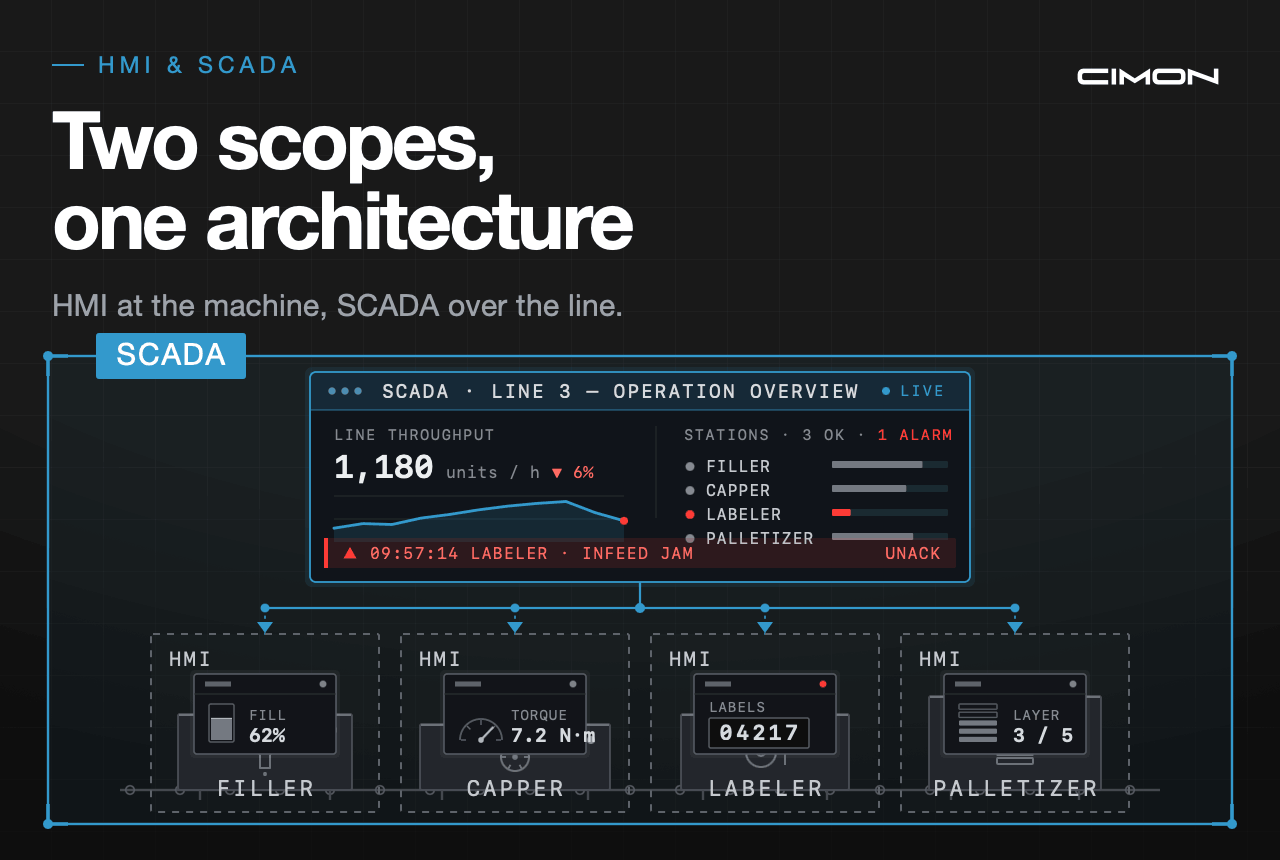
An HMI answers a local question. What is this machine doing right now, and what should the operator do about it? It lives at the equipment: one operator, one machine or cell, one field of view. It can log and trend that machine's data perfectly well, so “HMIs don't store data” was never quite true and is certainly not true now. What defines an HMI is not its feature set but its boundary. It is responsible for the equipment it is attached to, and nothing past it.
SCADA answers a supervisory question. What is happening across the whole operation, and how do we coordinate it? It sits above many machines, many PLCs, often many sites. It pulls those sources into one place, holds the long history, manages alarms across the operation, and gives a control room a view no single panel could assemble. A regional water system supervising dozens of unmanned pump stations is running SCADA. The defining trait is again a boundary, just a far larger one. SCADA is responsible for the operation, not the machine.
That is the line that survives the convergence, and the clearest proof is how vendors segment their own products. If the difference were really about hardware, they would split their lines that way. They do not. The major platforms sell an HMI product for the machine interface, a plant-level SCADA product, and an enterprise SCADA product, built on much the same technology and separated by how much of an operation each is meant to supervise. When a company running one software stack draws its own boundaries around scope rather than hardware, that tells you where the real line is.
What the larger scope requires
The shared features are why the line looks blurry up close. Both draw good graphics, both alarm and trend, both speak modern protocols like OPC UA. The capabilities that actually separate them are the ones that scale with the size of the job. A panel HMI is built for the tags on its machine. A SCADA system carries an entire operation's worth, with an architecture meant to grow into large tag counts. An HMI logs its own machine's data locally with modest retention. SCADA runs a dedicated time-series historian, usually backed by an enterprise SQL database, holding the years of history an operation needs for trending, troubleshooting, and compliance. External database connectivity is a SCADA assumption, not an HMI add-on.
Architecture is the sharper divide. An HMI is a single node, one panel and one operator. SCADA is client-server by design: one server acquires and stores the data, and many operator clients connect to it at once with role-based access, so a control room, a maintenance laptop, and a plant manager all see the same live system. Redundancy comes from the same need. A supervisory system watching an operation that cannot stop runs in redundant server pairs with automatic failover and synchronized history, so one failure does not blind the whole plant. A standalone HMI rarely needs that, and rarely has it.
Connectivity follows the same logic. An HMI usually talks to the PLC it is bolted to. SCADA has to pull together heterogeneous equipment from across the operation, which is why supervisory platforms ship with large driver libraries rather than a handful of protocols. None of this is a feature an HMI forgot to include. It is what supervising a whole operation demands. The capabilities differ because the size of the job differs.
How they sit together
Picture the two working together rather than against each other. Take a bottling line with eight machines, each with its own panel. The operator at the filler works the filler's HMI: speed, fill level, the fault in front of them. Up in the control room, SCADA subscribes to all eight machines plus the utilities feeding them, trends the whole line's throughput, and raises the alarm when downtime on machine three starts dragging the line's output. The HMI is where a person runs one machine. SCADA is the layer that watches the line.
Neither is doing the other's job. An HMI runs fine with no SCADA behind it, and most standalone machines do exactly that. A SCADA system with weak interfaces beneath it is miserable to operate. They are different layers of one architecture, which is why a vendor can bundle them and still be selling two distinct things. Newer architectures complicate the picture in a different way. In a unified namespace, an MQTT broker becomes the shared source of truth and SCADA becomes one subscriber on it rather than the system polling every device. The supervisory role stays the same. What makes it supervisory is the reach of the job, not the box it runs in.
Why scope drives the decision
All of this becomes concrete the moment a system gets scoped, because the two are priced and licensed on different assumptions. A panel HMI is licensed for the machine in front of it. A supervisory platform is licensed for an operation, historically by tag count and now sometimes by server with unlimited tags. The model you are quoted reflects the scope you are buying. Matching the tool to the scope is what keeps a system from either carrying weight it never uses or being stretched past what it was built to hold.
Which makes the opening question of any project a simple one, worth asking before the product names come up at all. Is the job to run a machine, or to supervise an operation? Asked plainly, the answer is usually obvious, and it points cleanly at one layer or the other. When the honest answer is both, that is not a contradiction. It is the normal shape of a plant that runs HMIs at the machines and SCADA over the top.
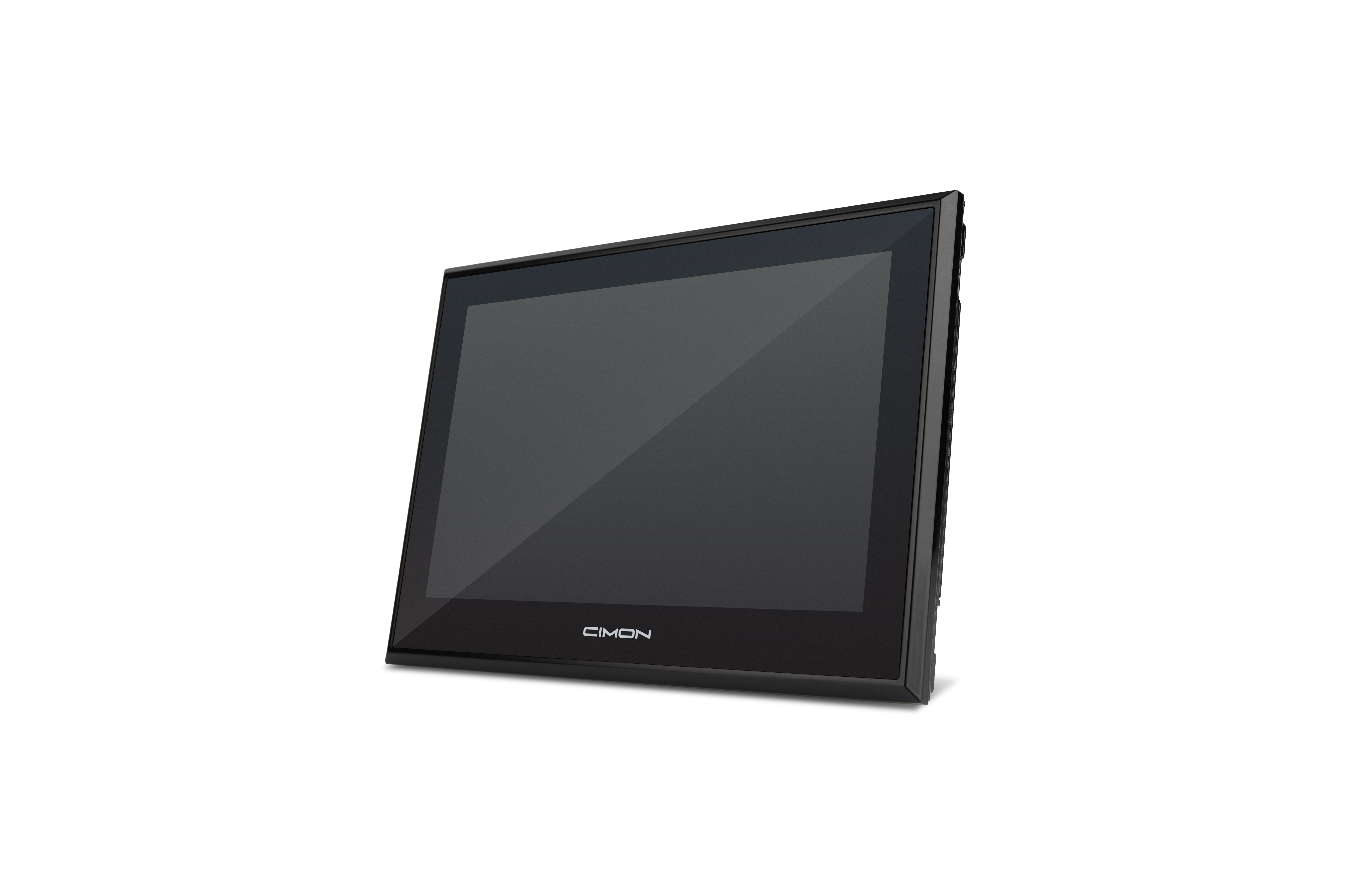
For our part, CIMON makes both, which is why we have no reason to blur the line. The CIMON eXT2 panel running CIMON Canvas is the HMI at the machine, hardware and software built for the interface in front of the operator. CIMON UltimateAccess Web is SCADA, built for supervision across the plant and reached through a browser. The server runs wherever it makes sense, on site or centralized, and operators open the live system from any device with no dedicated control-room workstation. Under that interface it is built for operation scope, with a time-series historian on PostgreSQL and TimescaleDB, redundancy and failover, and hundreds of drivers to aggregate the equipment across a plant.
It is still SCADA because its job is the whole operation, not one machine. Canvas and UltimateAccess Web are not a larger and smaller version of the same thing, and they are not one product under two names. They are two layers of the same architecture, and the right design often uses both, each doing the job its scope defines.
The unified namespace we mentioned earlier points at a larger shift worth its own discussion. As more plants move to a shared data backbone, the supervisory layer starts to look less like a single system in a control room and more like a role spread across the architecture. That does not make SCADA disappear. It changes where the supervisory job lives. That shift, and what it means for how plants design the supervisory layer, is where a follow-up piece picks up.